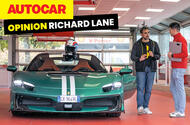
Ferrari is fully booked up for F1 next year – so perhaps a role with the road cars would suit?
So you want to be a Ferrari test driver, eh? The good news, says the man who would be making this irresistible job offer, is that you have longer than you perhaps thought: Raffaele de Simone’s recruiting cut-off is 40 years old.
But note that it could then take you a decade to join the programme for something serious like the 296 Speciale. Ferrari’s chief test driver since 2014, who I was lucky enough to have dinner with on the Speciale launch, started earlier than most. He was just 19 and still an engineering student when he joined Dario Benuzzi’s team. His first project? The Enzo. Hard to believe.
Events were put in motion during a race weekend at Misano. It was the first semi-public outing for an Enzo prototype, with Benuzzi at the wheel and Piero Ferrari riding shotgun. Benuzzi, if you need reminding, had signed off the dynamics of every Ferrari since the Dino and is still Maranello’s most celebrated test driver (although, given the recent run of stellar models, de Simone is certain to inherit that status).
This was back in 2001. De Simone was sitting on the grid, transfixed by this wild pre-Enzo through his visor when he should have been zoning in for a race start. It was a powerful moment that left “a permanent image”,
Later that day, de Simone managed to take down Benuzzi’s phone number while both their cars were stuck in traffic leaving the circuit. Talk about sliding doors. Then came an interview and the offer of a full-time salary, although Ferrari would also allow him time to finish his degree. All he needed to do was give up on a career in top-tier GT racing. Not an easy decision, but the opportunity at Ferrari was too sweet.
I ask about the master Benuzzi’s driving style: “Careful. He had probably scared himself many times driving the Daytona or cars like this that were not braking well. Plenty of margin before the limit. He was not a fast driver, but you don’t need to force the pace to understand the car.”
De Simone doesn’t so much as imply it, but it’s clear Benuzzi and Amedeo Felisa saw something rare in his blend of engineering mind, racer’s synapses and the crucial love of driving. He dispassionately says he is just one part of a testing ecosystem that is now 400 people strong: “I represent the role of head of test drivers. If it were not me, it would be another, but with the same scheme of applying the company’s logics.”
While Ferrari still signs up talent before graduation, it’s unlikely any teenagers worked on the F80. The path to developing begins with testing, usually for nine years. The difference? Development drivers work with prototypes while testers shake down completed customer cars. The latter is a ‘pure driving’ job, where you test everything from water ingress to ADAS tuning and ensure the car stops in a straight line and corners symmetrically.
To even stand a chance of moving into development, you must also be able to quickly discern between, say, two identical 12Cilindri models that have rolled off the line, based on production discrepancies and the tolerance variations in supplied parts. How long to develop that feel? Three years.
Not crashing is also a good idea. It can be very upsetting for the client. Although, based on 2024’s production of 13,700 cars and 40 minutes of shakedown for each, accidents are inevitable.
But if you’re talented and don’t crash much, the door to development is open. In the earliest assessments, de Simone overloads the budding developer with information at Fiorano to see how they cope. They must adapt fast, changing driving style and remembering commands. And they must enjoy it, as “we sell fun, not only cars”.
You then move into durability, where you’re introduced to prototypes approved by more senior staff. It’s tough work: instead of 40 minutes in a lavish, finished car, you spend seven hours in a far more complex environment, where you need “to speak with her, to learn her”, knowing the timbre of a squeak that leads to a failure.
And again, don’t crash. The Speciale prototypes cost around €2 million each, and for durability the stakes are higher still: “If you’re at 200,000km and you break the car, you’re interrupting a very long test, so it’s €2m plus the time and the kilometres spent, and you will never know when [for example] the gearbox would have broken. It’s a big responsibility.”
So it’s a long road to the top, but the brightest sparks might one day have the chance to attempt that special, abstract, exceedingly difficult thing. Which is what exactly, Raffa?
“To put art in the car.”
Source: Autocar
