
Storming 200mph supercar finally heading to showrooms in the next two years to take on AMG GT
Toyota has finally revealed its new flagship V8 supercar – due on sale in around two years as a storming, 641bhp rival to the Mercedes-AMG GT and Aston Martin Vantage.
The GR GT – named for Toyota‘s Gazoo Racing performance division – is described as having been conceived as a “road-legal race car”. Indeed, the road-going and GT3-spec racing versions have been revealed simultaneously, reflecting the fact that they were engineered completely in parallel.
The main focus, says Toyota, was to “endow the car with a high level of dynamic performance but also to achieve a sense of car-driver unity”. To that end, company chairman and ‘Master Driver’ Akio Toyoda worked closely with the car’s developers, with assistance from some of Japan’s most accomplished racers.

Together with the related but pure-electric Lexus LFA, the new Toyota supercars form what the company calls a ‘trinity’ of high-performance flagships aimed at emphasising its engineering prowess and technical capabilities – honed on the race track.
Another priority during development was to pass on “the secret sauce of car making” to the next generation of Toyota engineers, so people who worked on the original LFA programme were actively involved in the conception of the new supercars.
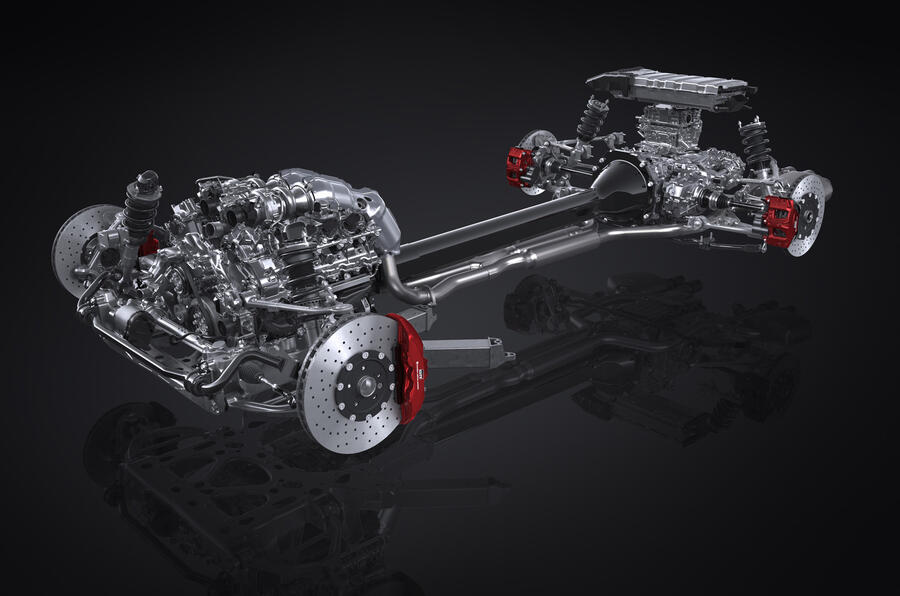
Japan’s answer to the Mercedes-AMG GT uses a new 4.0-litre twin-turbo V8 as part of a hybrid drivetrain that pumps a targeted 641bhp and 627lb ft to the rear wheels through a carbonfibre-reinforced torque tube – though the company says development is still ongoing and the final figures could be higher.
No performance figures have been disclosed yet beyond a target top speed of at least 198mph, but a 0-62mph time in the region of 3.5sec is well within reach.
The engine itself is described as “thoroughly light and compact”, courtesy of its ‘hot vee’ arrangement – with the turbos mounted inside the cylinder banks – as well as the dry-sump lubrication system and slimline oil pan.
Toyota will no doubt use the engine in other applications, given the considerable time and expense that has gone into its creation, but it has not yet given any clues as to what these could be. Crucially, though, it says it will make the motor compliant with “increasingly stringent emissions regulations” so it can remain in production for years to come.
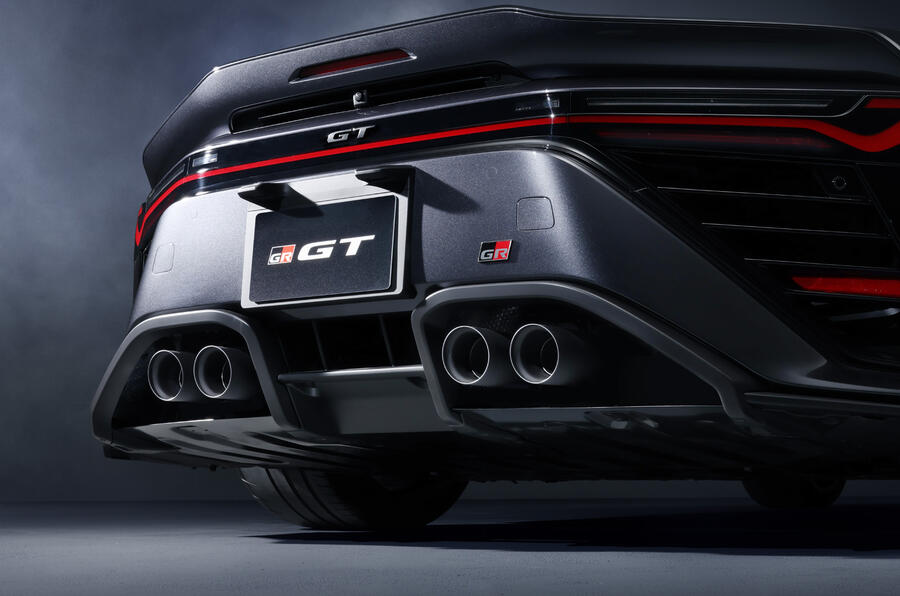
The soundtrack was a central component of the engineering process. Toyota wanted the V8 to deliver “not only high-level performance but also the distinctive racing sound of a V8 twin-turbo engine”. It says the exhaust has been “meticulously crafted to produce sound that synchronises with the state of the vehicle”.
It sends its power through an eight-speed automatic gearbox – also all new – which, like the seven-speeder in the AMG, features a wet clutch instead of a torque converter to help provide “world-class shift speeds”, and a mechanical limited-slip differential.
The EV motor (for which no specs have been given) is mounted ahead of the gearbox and serves to fill the gap between gearchanges to avoid any loss in torque.
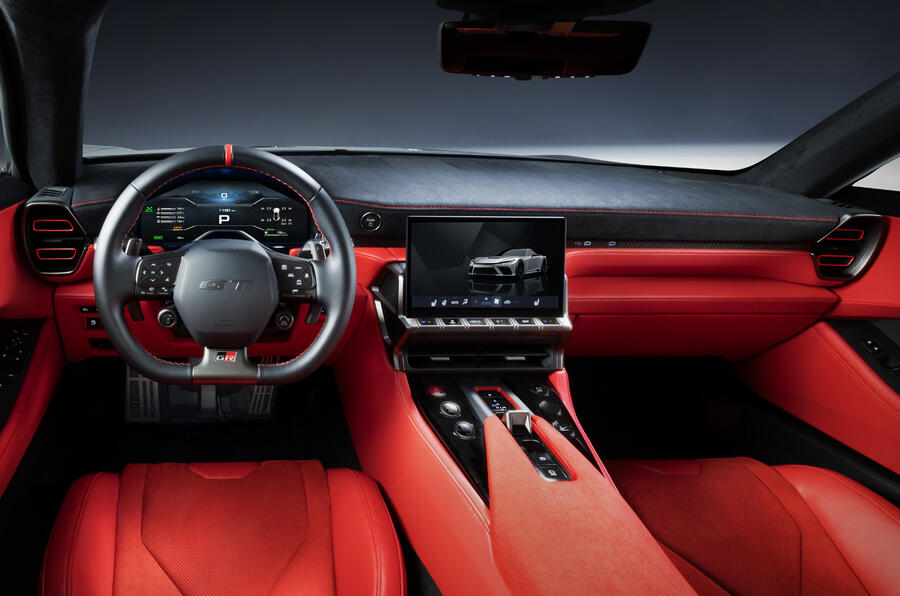
The GR GT’s race-honed conception is evident in its aerodynamically optimised styling and driver-focused cockpit, which, Toyota says, has been optimised for use by “both professional and gentleman drivers” while also being geared towards both track and daily driving.
Notably, neither version of the GR GT features a Toyota badge anywhere on its exterior or interior, in line with the carving out of GR as its own dedicated brand within the Toyota group, like Lexus or Century.
Priorities for the cabin were to maximise visibility, enhance the sense of protection and offer “the ideal driving position”. Special focus has been placed on ensuring all switches are suitably shaped and easy to reach, with a view to achieving “excellent operability”.
Keeping weight down and maximising rigidity are the other core pillars of the GR GT’s development, with Toyota aiming for the GR GT to offer “a linear response and a high level of controllability” whether on track or in town.
It is the first Toyota with an aluminium body-in-white, and the panels on top are partly aluminium too, as are the main suspension components – while the brake discs are carbon units from Brembo.
The end result is that the GR GT will tip the scales at less than 1750kg, Toyota said, which will make it around 300kg lighter than the four-wheel-drive AMG and almost exactly the same kerb weight as the rear-driven Aston Martin Vantage.
That low kerb weight, split 45% front and 55% rear – in conjunction with a specially developed stability control system based on Toyota’s Le Mans racer – will help the GR GT achieve its objective for “the driver to interact seamlessly with the car on circuits, as well as on winding roads and other public highways”.
Source: Autocar
